Blocking lipid production in healthy lung cells can reduce lung metastasis
Leuven, 17 March 2026 - Scientists from the VIB–KU Leuven Center for Cancer Biology, in collaboration with the Francis Crick Institute, have discovered how cancer cells can exploit healthy lung cells to support metastatic tumor growth in the lungs. In two complementary studies published in Nature Cell Biology and Cancer Discovery, they show that tumors use lipids produced by lung cells as signals, and that decreasing the lipid production of lung cells can decrease metastasis. The findings point to new therapeutic strategies that target lung cell lipid production, rather than cancer cells themselves, which may also help refine patient selection for ongoing clinical trials targeting this pathway.
Cancer is one of the leading causes of death worldwide, largely due to metastasis – the spread of cancer cells from the original tumor to other parts of the body. The lungs are among the most common sites where metastases form, including for breast cancer. Once metastasis is established, therapeutic options become limited and the disease is generally considered incurable.
A critical aspect of metastasis formation is the establishment of a specialized environment in distant organs that supports the function of the cancer cells. Within this environment, resident cells (cells that permanently reside within tissues to maintain structure and function) provide cancer cells that grow as secondary tumors with essential signals for their survival and proliferation, further promoting the progression of tumors.
Cancer cells reprogram healthy lung cells to support metastasis
In breast cancer-derived lung metastasis, previous research from the team of Sarah-Maria Fendt, professor at the VIB-KU Leuven Center for Cancer Biology, has shown that a specific type of lung-resident cells, called alveolar type II (AT2) cells, prepare distant organs for the arrival of cancer cells. Yet, little is known about their role once metastases are established. Filling this knowledge gap could open new avenues for treatment.
The teams of Prof. Fendt and of Mariia Yuneva, professor at the Francis Crick Institute, investigated how AT2 cells interact with breast cancer-derived lung metastases to better understand their role in tumor growth.
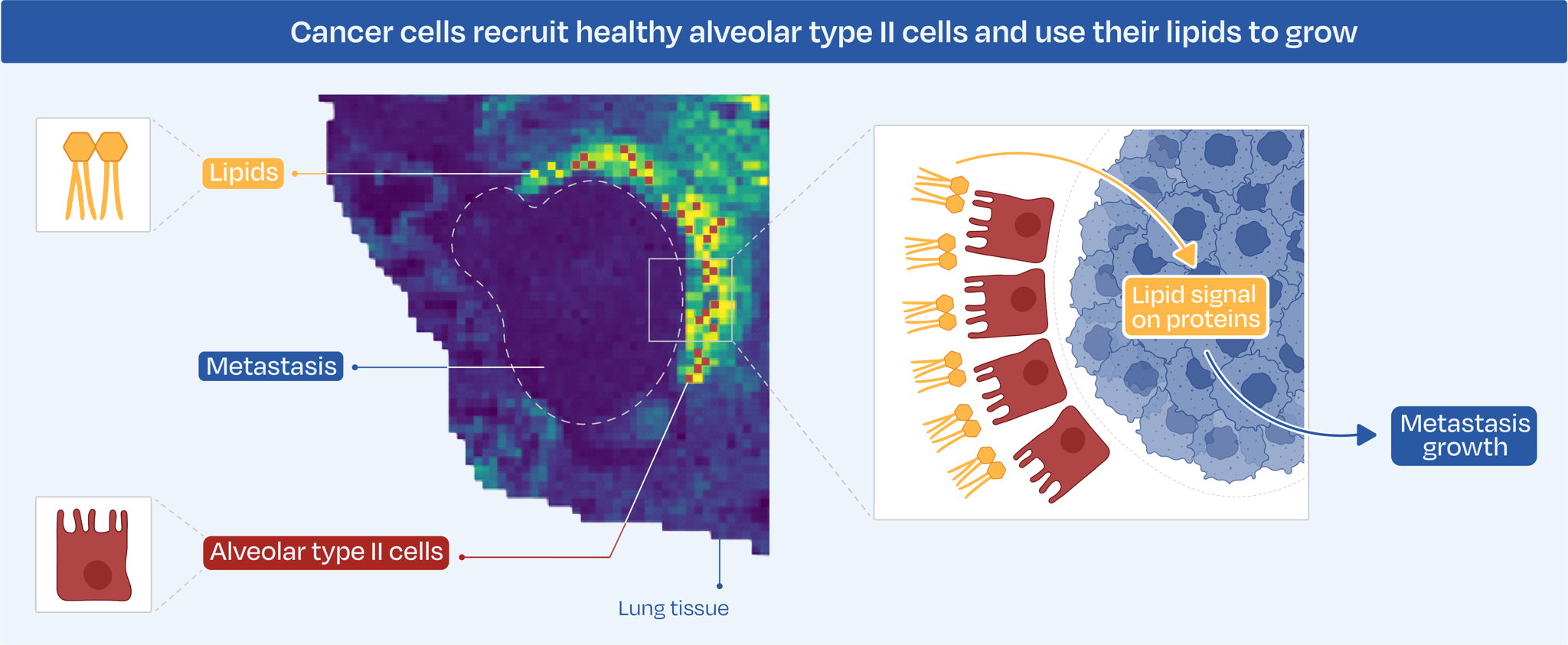
“We discovered that cancer cells recruit AT2 cells and reprogram them to produce more lipids for them,” explains Dr. Xiao-Zheng Liu, first author of the study published in Cancer Discovery and postdoc at the VIB-KU Leuven Center for Cancer Biology.
The researchers also found that reducing the amount of available lipids derived from AT2 cells hindered the cancer from growing further.

“Rather than targeting cancer cells directly, it may also be possible to target other cells that boost their growth, which could open new options for possible treatments,” explains Liu.
Importantly, the collaboration between the two institutes made the findings of the study even stronger.
"We were able to obtain the same results in different laboratories, with different models and with different techniques. Bringing our complementary expertise together made the study very robust," explains Prof. Yuneva.
Cancer cells use lipids from healthy lung cells to drive metastasis
Another key question was how cancer cells use the lipids supplied by lung cells. Because lipids are high-energy molecules, they were long thought to mainly serve as an energy source. Yet, in a second complementary study from the laboratory of Prof. Fendt, the researchers found that cancer cells also use lipids as signals to modify proteins and regulate their function inside the cell.
These lipid modifications of proteins enable cancer cells to change their molecular profile and increase their own growth in the lung.
“By studying a specific lipid component called palmitate, we identified the pathway that triggers these molecular changes in the cell and promotes lung metastasis,” explains Dr. Ming Liu, first author of the study published in Nature Cell Biology.

Prof. Sarah-Maria Fendt contextualizes the importance of the discovery.
“The key insight was that these lipids are not just used as an energy source. Instead, they initiate the molecular pathway that enables cancer cells to modify themselves and grow. When we interrupt this process, we can block metastatic growth.”
Refining patient selection for targeted therapies
Currently, several clinical trials are investigating drugs that inhibit lipid production. However, identifying which patients are most likely to benefit from these treatments remains challenging.
“Our findings suggest that these inhibitors may best work in patients whose metastasis recruit large amounts of AT2 cells. This insight helps refine the group of patients who may benefit most from these therapies,” explains Prof. Fendt.
Together, the studies also point to the potential role of AT2 cells in supporting the tumor growth of other lung-residing tumors. Although a direct link between AT2 cell-derived lipids and the formation of primary lung cancer is yet to be made, the observed interactions point to a possible role for the AT2 cell lipid metabolism in lung cancer growth.

Publications
Targeting the Lipid Metabolism Proteins FASN and GPAM in Alveolar Type II Cells Decreases Lung Metastasis. Xiao-Zheng Liu, et al. Cancer Discovery, 2026. DOI: 10.1158/2159-8290.cd-25-0191.
Palmitoylation-mediated regulation of KAT2A promotes lung metastasis in breast cancer. Ming Liu, et al. Nature Cell Biology, 2026. DOI: 10.1038/s41556-026-01913-z
Funding
The research team at the VIB-KU Leuven Center for Cancer Biology was financially supported by the main project grants: World Cancer Research Fund International, Stichting tegen Kanker, Cancer Research UK, and FWO; and supported by the main personal fellowships: FWO, German Research Foundation, EMBO, and Chinese Scholarship Council.
Press contacts:
- Sooike Stoops: sooike.stoops@vib.be: +32 474 28 92 52
- Prof. Sarah-Maria Fendt: sarah-maria.fendt@kuleuven.be
About the VIB-KU Leuven Center for Cancer Biology
Cancer has many causes. Often it is a combination of lifestyle, environmental factors and genetic variation. We need to fight cancer on many fronts, and this can only be done by using knowledge. The VIB-KU Leuven Center for Cancer Biology researchers unravel new mechanisms in order to develop both specific diagnostic methods and treatments.