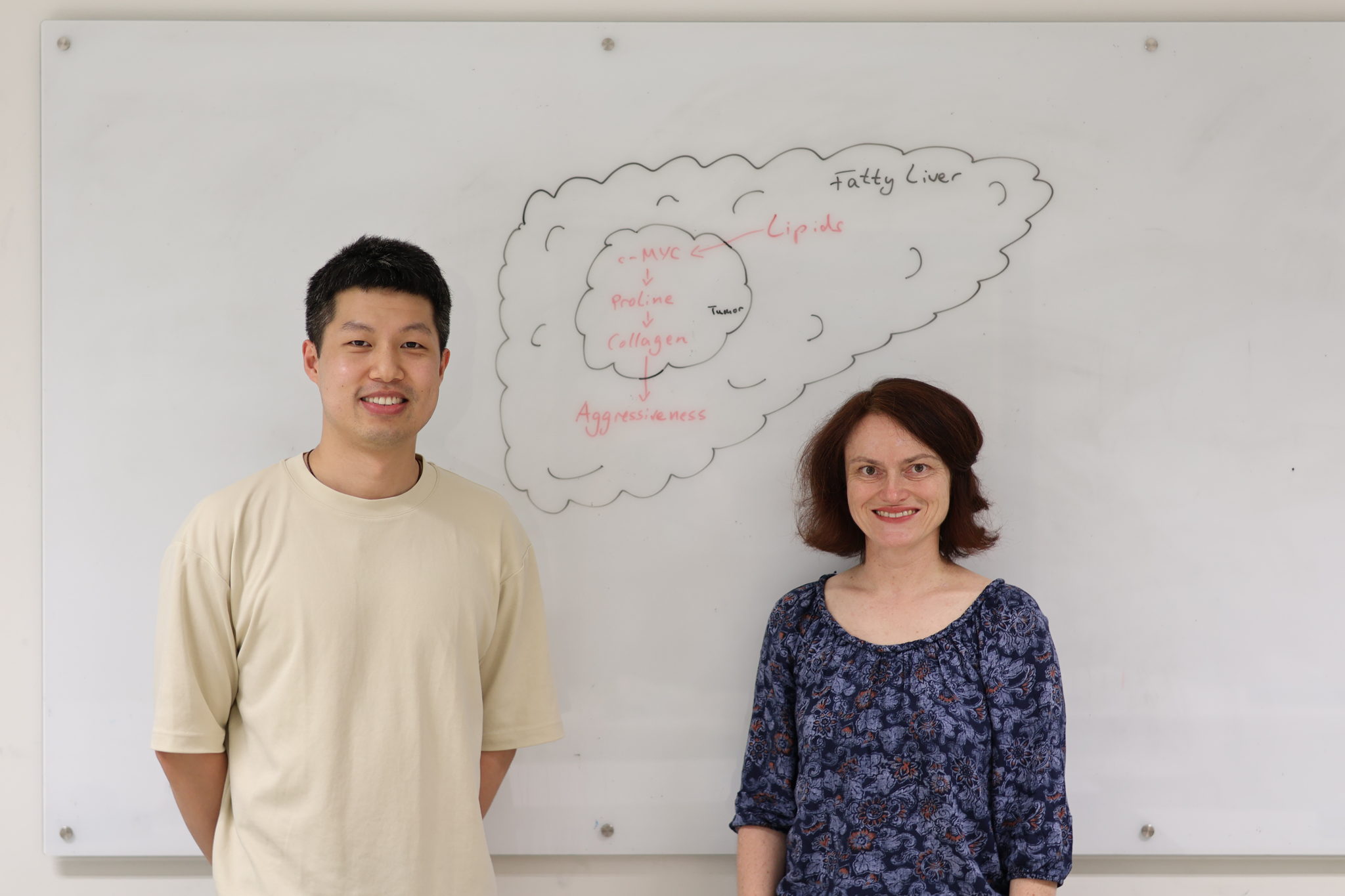
.jpg "Dr. Yiming Peng-Winkler and Prof. Sarah-Maria Fendt")
Fatty liver drives a more dangerous form of cancer spread
Leuven, 1 July 2026 – Researchers at VIB and KU Leuven, with international partners, have uncovered how fatty liver disease can fuel the most aggressive form of metastatic colorectal cancer. The findings, which appear in the leading journal Nature, not only explain why some patients face dramatically poorer outcomes but also highlight how metabolic conditions such as fatty liver disease may directly influence cancer progression, paving the way for more precise therapies tailored to a patient’s metabolic health.
Colorectal cancer (CRC) remains one of the leading causes of cancer-related death worldwide, accounting for nearly 1 in 10 cancer diagnoses, and is now the leading cause of cancer-related death in people under 50. A major reason for these poor outcomes is that up to 50% of patients develop secondary tumors in distant organs - primarily the liver - known as metastases, which dramatically reduces survival.
Among the patients who develop metastases in the liver, survival is strongly affected by how tumors grow within the liver. Strikingly, patients with metastases that remain separated from healthy liver tissue, so-called encapsulated metastases, can reach 5‑year survival rates of around 73%. In contrast, patients with replacement metastases, where cancer cells infiltrate and interact with healthy liver tissue, face a much more aggressive disease, with survival rates dropping to below 44%.
Despite this clear clinical divide, there is still a limited understanding of what drives the development of these aggressive metastases, and no therapies specifically targeting them, leaving a major unmet need for patients with poor-prognosis disease.
A common metabolic condition with unexpected consequences
A new study led by the lab of Prof. Sarah- Maria Fendt (VIB-KU Leuven Center for Cancer Biology) identifies a key, lifestyle-related factor that helps explain why some patients develop these high-risk metastases: fat accumulation in the liver, known as liver steatosis or fatty liver.
By analyzing patient samples alongside experimental models, the researchers found that patients with fatty liver are significantly more likely to develop aggressive replacement metastases. This is particularly important given the rapidly increasing prevalence of fatty liver disease worldwide, driven by rising rates of obesity and metabolic disorders.
“This work shows that a condition we typically consider a background metabolic issue can directly shape how cancer behaves,” says senior author Prof. Sarah-Maria Fendt (VIB-KU Leuven). “It highlights that the patient’s physiology is not just a bystander, but an active determinant of disease progression.”
How fat reshapes tumor biology
The study also uncovers the molecular mechanism that links fatty liver to aggressive cancer spread. In fatty livers, elevated levels of fatty acids rewire the metabolism and behavior of cancer cells by stabilizing the protein MYC, a well-known driver of cancer growth. Stabilized MYC increases the production of proline, an amino acid that serves as a key building block for collagen. This collagen creates a structural environment that allows the tumor cells to infiltrate and expand within the liver, giving rise to replacement metastases.
“In simple terms, the fatty liver provides both the signal and the construction materials that tumors need to grow more aggressively,” explains Fendt. “It fundamentally changes the rules of how metastases develop.”

Immediate impact: improving clinical trial success
One of the most immediate and tangible impacts of this work lies in improving how cancer patients are selected for clinical trials. Drugs targeting MYC are already being tested in patients for safety, but their clinical success depends on identifying those who are most likely to benefit.
This study provides a potential solution by showing that these drugs may be most effective in patients with fatty liver and replacement metastases, offering a clear strategy for patient selection.
“This gives us a powerful new way to stratify patients,” Fendt notes. “By identifying those most likely to benefit, we can make clinical trials more efficient and ultimately bring effective treatments to patients faster.”
Improved patient selection could increase trial success rates, reduce unnecessary treatments, and accelerate the development of targeted therapies.
Opening new avenues for treatment
Importantly, the study shows that this process can be exploited. By targeting different steps in this pathway - such as the MYC protein, proline production, or collagen formation - the researchers were able to significantly reduce the formation and growth of aggressive metastases in advanced experimental systems, including patient-derived tissue models.
These findings point to new therapeutic opportunities that are tailored to the patient’s metabolic condition.
“Our results suggest that we can intervene at multiple levels of this process,” says Fendt. “This creates entirely new possibilities for designing therapies that specifically target the most dangerous forms of metastatic disease, particularly in patients with liver conditions such as steatosis.”
Crucially, the study highlights the importance of integrating metabolic health into cancer care. Liver fat content could potentially serve as a biomarker to guide treatment decisions and predict disease progression.
“This work shifts our perspective,” says Dr. Yiming Peng-Winkler (VIB-KU Leuven, University Hospital Düsseldorf), first author of the study. “It shows that, to effectively treat cancer, we need to consider not just the tumor, but also the environment it depends on. Only then can we design truly precise and effective therapies.”
A broader shift in understanding cancer
More broadly, the study highlights a fundamental principle: cancer progression is shaped not only by tumor cells themselves, but also by their environment in the body. By revealing how fatty liver disease fuels aggressive metastasis, this research provides both a mechanistic explanation for differences in patient outcomes and a roadmap for improving them.
As metabolic diseases continue to rise worldwide, these insights may become increasingly important, not only for understanding cancer biology but also for transforming how patients are diagnosed, stratified, and treated in the future.
Publication
Steatosis shapes prognosis-defining liver metastasis heterogeneity in CRC. Peng-Winkler et al. 2026. Nature.
Funding
This work was supported by the German Research Foundation, EMBO, FWO, the Gilead Sciences Research Scholars Program in Solid Tumors, the Beug Foundation, the China Scholarship Council, the Else Kröner-Fresenius-Stiftung, the Terry Fox New Frontiers Program, the National Decade Against Cancer, Fonds Baillet Latour, Francqui Stichting, Foundation ARC, Stichting tegen Kanker, Wereld Kanker Onderzoek Fonds.
Questions from patients
A breakthrough in research is not the same as a breakthrough in medicine. The realizations of VIB researchers can form the basis of new therapies, but the development path still takes years. This can raise a lot of questions. That is why we ask you to please refer questions in your report or article to the email address that VIB makes available for this purpose: patienteninfo@vib.be. Everyone can submit questions concerning this and other medically-oriented research directly to VIB via this address.

Gunnar De Winter

Kristof Windels