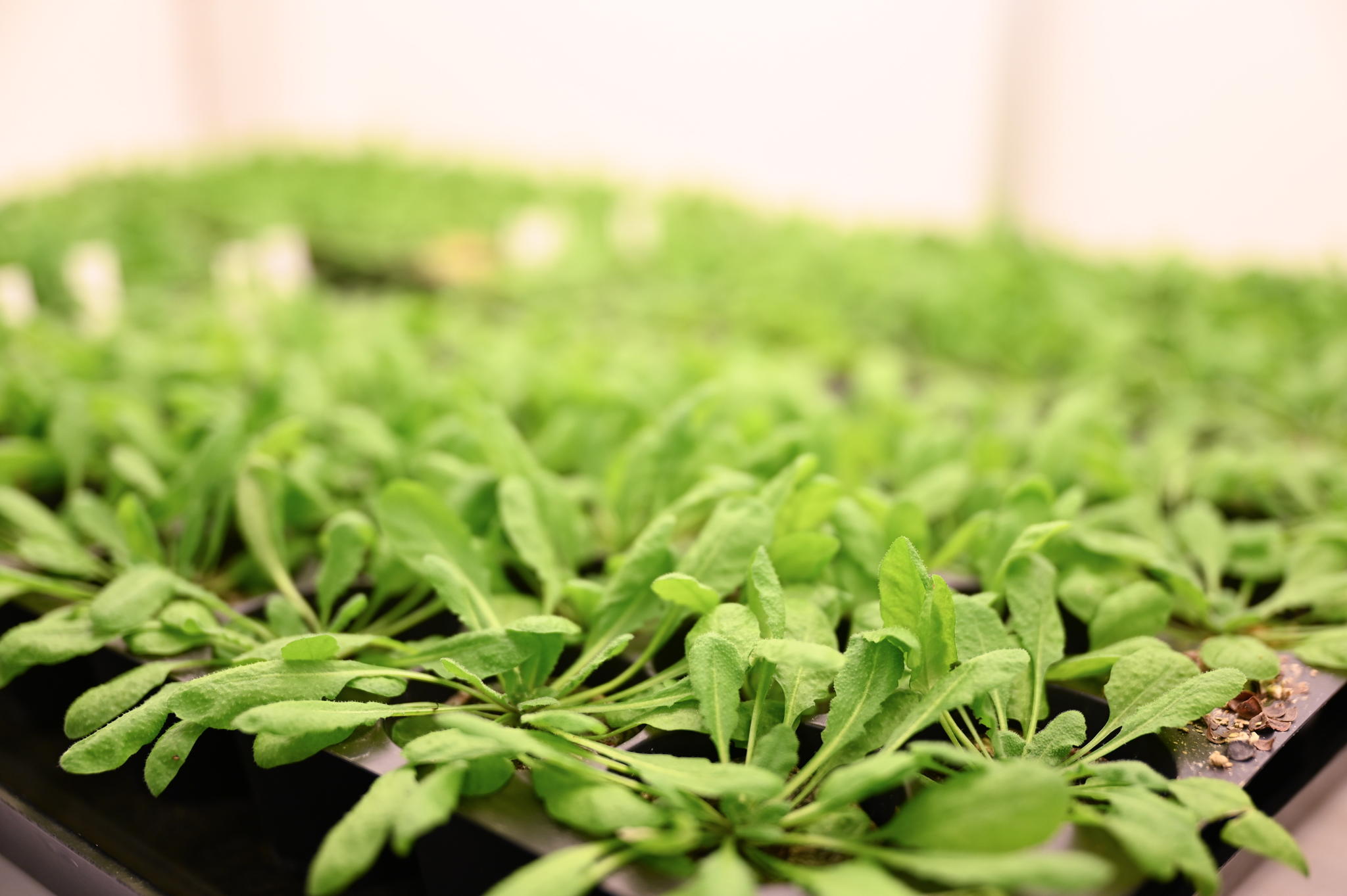
.jpg "Arabidopsis thaliana (@VIB-IneDehandschutter)")
How plants keep their root hairs alive and why that matters for crop resilience
Ghent, Belgium – 12 May 2026. Plants rely on millions of tiny hairs on their roots to absorb water and nutrients from the soil. Now, a research team at VIB and UGent led by Prof. Moritz Nowack, has discovered that the lifespan of these root hairs is governed by a surprisingly precise molecular balancing act between recycling and cell death. The findings, published in Nature Plants, open new avenues for engineering crops that are better at extracting resources from the soil.
Tiny structures of great importance
Root hairs are so small that they are invisible to the naked eye. Yet their collective contribution to a plant's ability to absorb nutrients and water is enormous — they can increase the effective surface area of a root system by orders of magnitude. Scientists already understand quite well how root hairs grow, but what controls how long they live has remained largely a mystery.
"We know a great deal about how root hairs form and grow, but how long they stay functional as the root ages had basically been a blank page," says Prof. Moritz Nowack (VIB-UGent Center for Plant Systems Biology), senior author of the study. "That turned out to be a much more interesting story than we expected."
The team's first hint came from an unexpected observation: root hair cells in the model plant Arabidopsis thaliana run their autophagy machinery at unusually high levels compared to other root cells. Autophagy (from the Greek for 'eating yourself') is the process cells use to break down and recycle their own damaged or surplus components. It acts as a kind of internal quality control, keeping the cellular environment clean and functional, which is important to keep plant organs such as leaves alive and functional over extended periods of time.
When the researchers switched off key autophagy genes, root hairs collapsed and died far earlier than normal. The cells were triggering a self-destruction sequence prematurely.
"What we found is that root hair cells are essentially running autophagy at full throttle to hold back an age-induced programmed cell death process," says Nowack. "The moment autophagy is disabled, the brakes come off and the cells start dying too soon."
.jpg "Prof. Moritz Nowack (@VIB-IneDehandschutter)")
Preventing premature cell death for crop resilience
The premature cell death the researchers observed had all the hallmarks of a controlled, genetically programmed cell death process that plant cells use during normal developmental events. Crucially, the team showed that when autophagy was restored specifically in root hair cells, the premature death was prevented. Each root hair is, in effect, managing its own survival.
Two transcription factors (proteins that switch other genes on or off) turned out to be the executors of this death program in the absence of autophagy. Plants lacking these proteins were protected from premature root hair death even when autophagy was disabled.
"What autophagy is doing is keeping this programmed cell death switched off for as long as the root hair is useful," says Nowack. "And the genes and proteins involved in doing so are the same across the plant kingdom, which suggests that the same principles apply in wheat, maize, rice, and other major crops."
This means that, beyond the basic biology, the findings carry practical implications. Root hairs with longer lifespans translate to more efficient uptake of water and nutrients, which could reduce the need for fertilizers and improve drought resilience.
Publication
Root hair lifespan is antagonistically controlled by autophagy and programmed cell death. Feng, Zhu, Wang, et al. Nature Plants, 2026.
Funding
This work was supported by the National Natural Science Foundation of China, the Shandong Provincial Government, Ghent University, ERC, the Austrian Academy of Sciences, the Austrian Science Fund, and the Vienna Science and Technology Fund.

Gunnar De Winter

Kristof Windels