Cancer cells hijack a fatty acid to escape immune attack in liver metastases
Researchers uncover how metastatic tumors suppress neutrophils and identify a promising therapeutic target
Leuven, 05 August 2026 – Liver metastases are among the most common and deadly forms of cancer spread. Now, researchers at VIB and KU Leuven, with international collaborators, have discovered how cancer cells exploit a fatty acid abundant in the liver to evade destruction by the immune system. By disrupting this process, the researchers restored the cancer-fighting activity of immune cells called neutrophils and reduced metastatic growth.
A nutrient-rich environment that favors cancer
The liver is a highly metabolically active organ and a frequent destination for metastatic cancer cells. While researchers have long known that tumors can exploit nutrients in their environment to support growth, much less was understood about how these nutrients influence the interactions between cancer cells and the immune system.
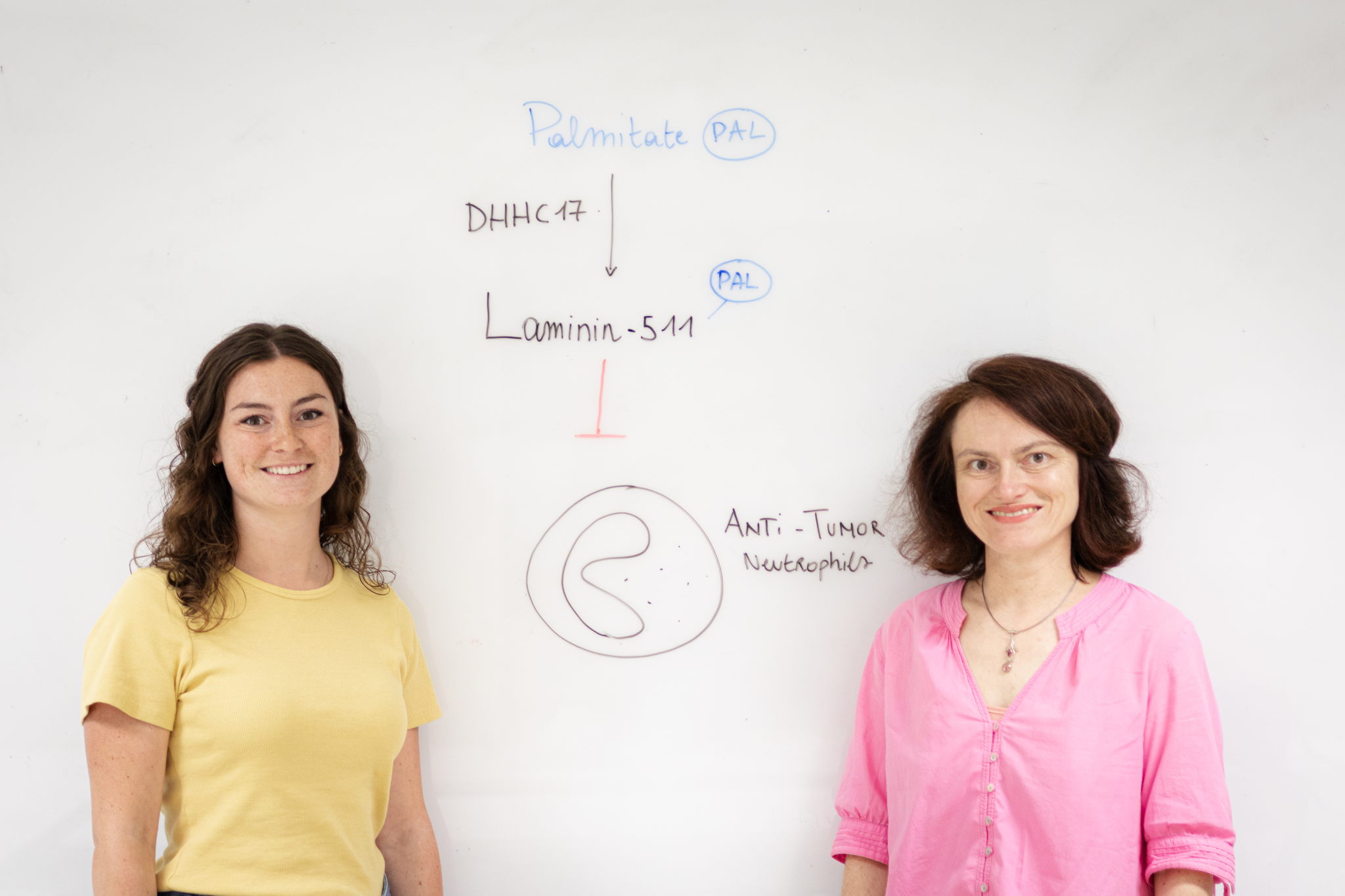
In this study, the team of Prof. Sarah-Maria Fendt (VIB-KU Leuven Center for Cancer Research) focused on palmitate – a naturally abundant fatty acid found in the liver – and palmitoylation – the process through which cells attach palmitate to proteins to regulate various cellular process. Researchers found that metastatic cancer cells attach palmitate to a protein called laminin-511 through the activity of an enzyme called DHHC17. Laminin-511 is a protein that regulates cell migration, tumor invasion and metastasis, which becomes more stable once palmitate is attached to it.
Turning defenders into accomplices
Importantly, laminin-511 is a protein that profoundly alters the behavior of nearby neutrophils. Neutrophils are best known as frontline defenders against infection, but they can also attack and eliminate cancer cells. Researchers discovered that laminin-511 suppresses this anti-tumor activity. Instead of killing cancer cells, neutrophils exposed to laminin-511 become more prone to forming neutrophil extracellular traps (NETs), which are web-like structures that can help tumors survive and grow.
By manipulating the enzyme DHHC17 in experimental models of liver metastasis, the team showed that reducing its activity decreased metastatic growth. Importantly, this effect depended on the presence of neutrophils, demonstrating that cancer cells use DHHC17 and laminin-511 specifically to evade immune destruction.
“Our findings reveal a new way in which metastatic cancer cells reshape their environment to protect themselves from immune attack,” says first author Dr. Anke Vandekeere (VIB-KU Leuven). “Rather than acting directly on the cancer cell alone, this pathway allows tumor cells to disarm neutrophils and undermine one of the body's natural defense mechanisms against cancer.”
A new avenue for metastatic cancer therapy
The findings add to the growing evidence that protein palmitoylation plays an important role in cancer progression and immune evasion. Previous studies had linked palmitoylation to tumor growth and immune regulation, but its role in the communication between metastatic cancer cells and neutrophils was largely unknown.
By identifying DHHC17 as a key regulator of this process, the study highlights a potential new strategy for future therapies aimed at restoring the immune system's ability to control metastatic disease. Targeting palmitoylation could simultaneously interfere with tumor-promoting signals and enhance immune-mediated cancer cell killing.
“Liver metastases remain extremely challenging to treat,” says Prof. Sarah-Maria Fendt (VIB-KU Leuven). “Understanding how cancer cells exploit the unique environment of the liver offers new opportunities to develop therapies that make these tumors more vulnerable to the immune system.”
A previous clinical trial that aimed to remove neutrophils entirely did not improve the effectiveness of immunotherapy in patients with solid tumors. This suggests that a better strategy may be to change how neutrophils behave within the tumor, rather than eliminating them altogether. By uncovering how metastatic cancer cells prevent neutrophils from attacking tumors, this new study points towards future treatments that could help the immune system fight cancer more effectively by turning neutrophils back into cancer-fighting cells.
Publication
Palmitate promotes liver metastases by decreasing neutrophil antitumour behaviour. Vandekeere et al. Nature Metabolism. 2026. DOI: 10.1038/s42255-026-01582-0
Funding
This work was supported by, among others, Research Foundation Flanders - FWO, Fonds Baillet Latour, Francqui Stichting, Foundation ARC, KU Leuven, Stichting tegen Kanker, and the World Cancer Research Fund. For a full list of funders, please see the paper.

Kristof Windels