How blocking immune cell signals could make brain tumors easier to remove
Leuven, Belgium, 27 October 2026 – In a new study published in Cancer Cell, researchers at VIB-KU Leuven reduced the spread of glioblastoma by interrupting specific interactions between the brain’s immune cells and tumor cells. The discovery points to a possible new therapeutic strategy, in which blocking communication between immune and cancer cells makes tumors more contained and easier to remove.
Glioblastoma is the most aggressive primary brain tumor in adults, with a median patient survival of about 15 months. Notoriously difficult to treat, tumor cells spread into the surrounding brain tissue, preventing the complete removal of the tumor. Total resection, however, is the strongest predictor of survival, meaning that finding ways to contain the tumor before surgery could be an important strategy to extend patients’ lives.
To discover how glioblastoma invasion can be blocked, researchers at the VIB-KU Leuven Center for Cancer Biology, led by Professor Gabriele Bergers, studied the interaction between tumor cells and microglia – the immune cells of the brain. Microglia promote glioblastoma progression by secreting certain proteins that tumor cells can use to grow. Yet, the role of lipids (fatty molecules) in this process has remained largely unexplored.
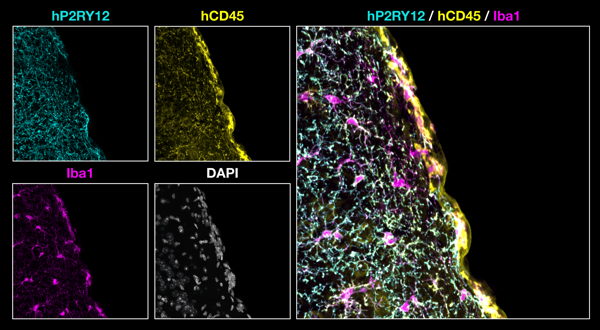
Using mouse models and tissue from glioblastoma patients, the researchers found that tumor cells use lipids released by microglia to become more mobile and invade healthy areas of the brain.
“We found that microglia release a specific type of lipid called lysophosphatidic acids (LPAs) that binds to tumor cells, activating pathways that help them spread to further areas of the brain,” explains first author Dr. Carla Pallarés-Moratalla (VIB-KU Leuven Center for Cancer Biology).
Stopping the invasion
Building on this initial discovery, the researchers investigated whether blocking this interaction could make tumors less invasive – and it did.
“We were able to interrupt these signals and make tumors less invasive,” explains Pallarés-Moratalla. “Although the size of the tumor did not change, these results raise the possibility of treating patients before surgery to make their tumors more contained and easier to remove. Because this approach limits spread but does not shrink the tumor, it could be combined with therapies that reduce tumor size, which could further improve patient survival.”
The researchers also looked for the same patterns in human samples, and tests on patient-derived tumor cell lines showed that immune cells promoted invasion in the same way as in mice.
“It was rather surprising to see how closely the mechanism we found in mice was reproduced in human glioblastoma, which suggests the findings could translate to patients,” says Pallarés-Moratalla.
The authors stress that these are still early findings, although the discovery opens the door to a new way of approaching treatment.
“Glioblastoma tumors are very heterogeneous, meaning that in the same patient, different areas of the tumor can carry different mutations,” explains Professor Bergers (VIB-KU Leuven Center for Cancer Biology). “But our approach does not target the genetic makeup of the tumor cells – it instead targets the communication between immune and cancer cells, which makes it applicable to a broader spectrum of glioblastoma.”
Publication
Macrophage lipid signaling drives glioblastoma invasion and represents a therapeutic vulnerability. Pallarés-Moratalla et al. Cancer Cell, 2026.
Funding
This work was supported by Research Foundation Flanders – FWO, Kom op Tegen Kanker, the EU’s Marie Skłodowska-Curie Doctoral Networks, Stichting Tegen Kanker, Dieter de Cauderlier Fonds voor Hersentumoren, KU Leuven, and the Wereld Kanker Onderzoek Fonds.