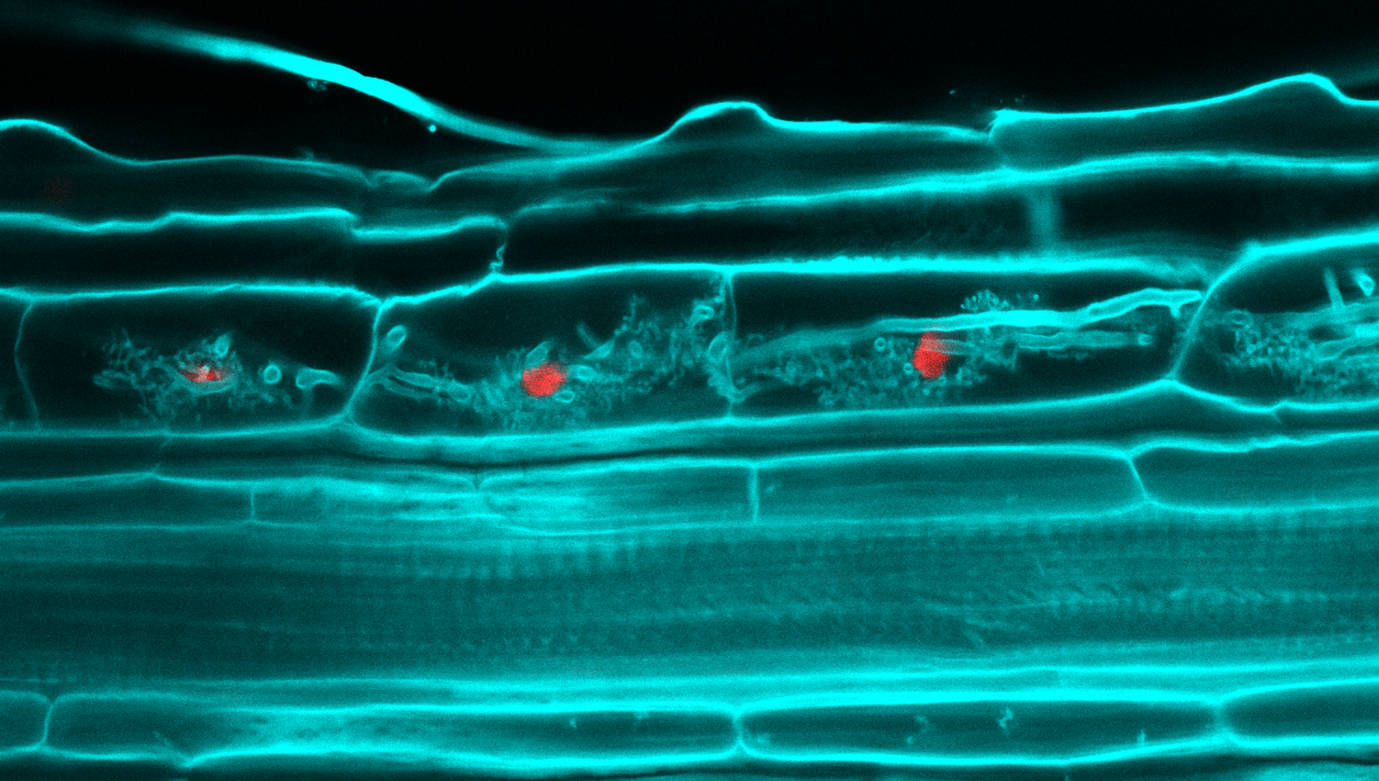
%20during%20distinctive%20stages%20of%20arbuscule%20development%20(1).png "Confocal image showing the specific activation of symbiotic regulators (red) during distinctive stages of arbuscule development. (@Naomi Stuer)")
Mapping plant-fungus symbiosis, cell by cell
Ghent, 18 August 2026 – Scientists at VIB and Ghent University have produced the first high-resolution, cell-by-cell map of how tomato roots respond to colonization by arbuscular mycorrhizal fungi. These ancient fungal partners help plants absorb nutrients from the soil. The study, published in Current Biology, reveals the precise molecular programs that unfold as the symbiosis progresses through different stages, and identifies promising new genetic regulators that could one day be used to engineer more efficient, sustainable crops.
In short:
- Single-cell study by VIB-UGent researchers led by Prof. Sofie Goormachtig reveals how tomato roots respond to arbuscular mycorrhizal fungi.
- Gene activity was mapped in nearly 66,000 individual root cells colonized by the fungus Rhizophagus irregularis.
- The researchers identified four successive stages of fungal colonization and nutrient-exchange development.
- These insights could help develop crops that use nutrients more efficiently and reduce reliance on synthetic fertilizers.
An ancient partnership, newly decoded
Arbuscular mycorrhizal fungi form symbioses with the vast majority of land plants, a relationship that dates back more than 400 million years. In exchange for sugars supplied by the plant, the fungi dramatically improve the plant's access to phosphate, nitrogen, and other nutrients, which reduces the need for chemical fertilizers.
"Despite decades of research," says Prof. Sofie Goormachtig (VIB-UGent Center for Plant Systems Biology), "the molecular details of how plants accommodate fungal structures called arbuscules – the main sites of nutrient exchange – inside their root cells remained poorly understood, largely because different stages of colonization occur simultaneously in the same root, making them difficult to separate using conventional methods."
A molecular snapshot, cell by cell
To tackle this challenge, the team of Prof. Sofie Goormachtig, with the help of the VIB Single Cell Core, used a cutting-edge technology that reads the activity of genes in individual cells one by one. Applied to tomato roots colonized by the fungus Rhizophagus irregularis, the approach generated gene activity profiles for nearly 66,000 individual cells. To ensure the team was looking at the right material, they used a fluorescent tag to light up root regions where the fungus was actively present, allowing them to zoom in on the most relevant tissue.
Within this dataset, the researchers identified a group of cells that responded specifically to fungal colonization.
"We found four successive stages of the interaction," explains Dr. Naomi Stuer (VIB-UGent), first author of the study. "Root surface cells sensing the arriving fungus, inner cells gearing up to let it in, cells in the process of building nutrient-exchange structures, and finally cells housing fully functional fungal structures ready for nutrient trade. Each stage has its own characteristic molecular signature, which helps us understand how the plant gradually rewires its cells as the partnership develops."
.png "Prof. Sofie Goormachtig, Dr. Naomi Stuer, and Dr. Judith Van Dingenen")
New molecular switches discovered
To find out which molecular switches, known as transcription factors, are pulling the strings at each stage, the team used MINI-EX, a computational tool to predict which regulators control which genes. The analysis confirmed many regulators already known to play a role in this symbiosis, but it also uncovered several previously unsuspected candidates. Three of these new candidates were then tested directly in living tomato roots, where they showed exactly the stage-specific activity the computational tool had predicted.
The study also brought several broader insights. First, a key signaling pathway previously thought to act only at the root surface turns out to remain active much deeper inside the root, throughout the formation of the fungal nutrient-exchange structures. Parts of this pathway may help prepare specific inner cortical cells for arbuscule formation by altering their metabolism and development. Because these cells look identical to other inner cortical cells, they have remained largely understudied, making this dataset one of the first glimpses into the early processes that precede arbuscule formation. Finally, the cells hosting mature fungal arbuscules appear to integrate information about the plant's overall nutrient status, suggesting that the plant carefully fine-tunes how much it invests in the symbiosis depending on how well-fed it already is.
"What excites me most about this dataset is that it doesn't just confirm what we suspected; it opens entirely new doors," said Dr. Judith Van Dingenen (VIB-UGent), co-senior author. "We can now pinpoint, with single-cell resolution, which genes are switched on or off at each stage of fungal colonization, and start asking why."
Towards smarter, more sustainable crops
Understanding the molecular logic of mycorrhizal symbiosis has direct practical relevance: plants that form more efficient partnerships with fungi can access soil nutrients more effectively, reducing dependence on synthetic fertilizers and improving resilience under stress conditions. The dataset and the candidate regulators identified in this study represent a valuable resource for future efforts to optimize the symbiosis in crops.
Publication
Decoding stage-specific symbiotic programs in the Rhizophagus irregularis–tomato interaction using single-nucleus transcriptomics. Stuer et al. Current Biology, 2026.
Funding
This research was financially supported by Ghent University, FWO – Research Foundation Flanders, and ERC.

Gunnar De Winter

Kristof Windels