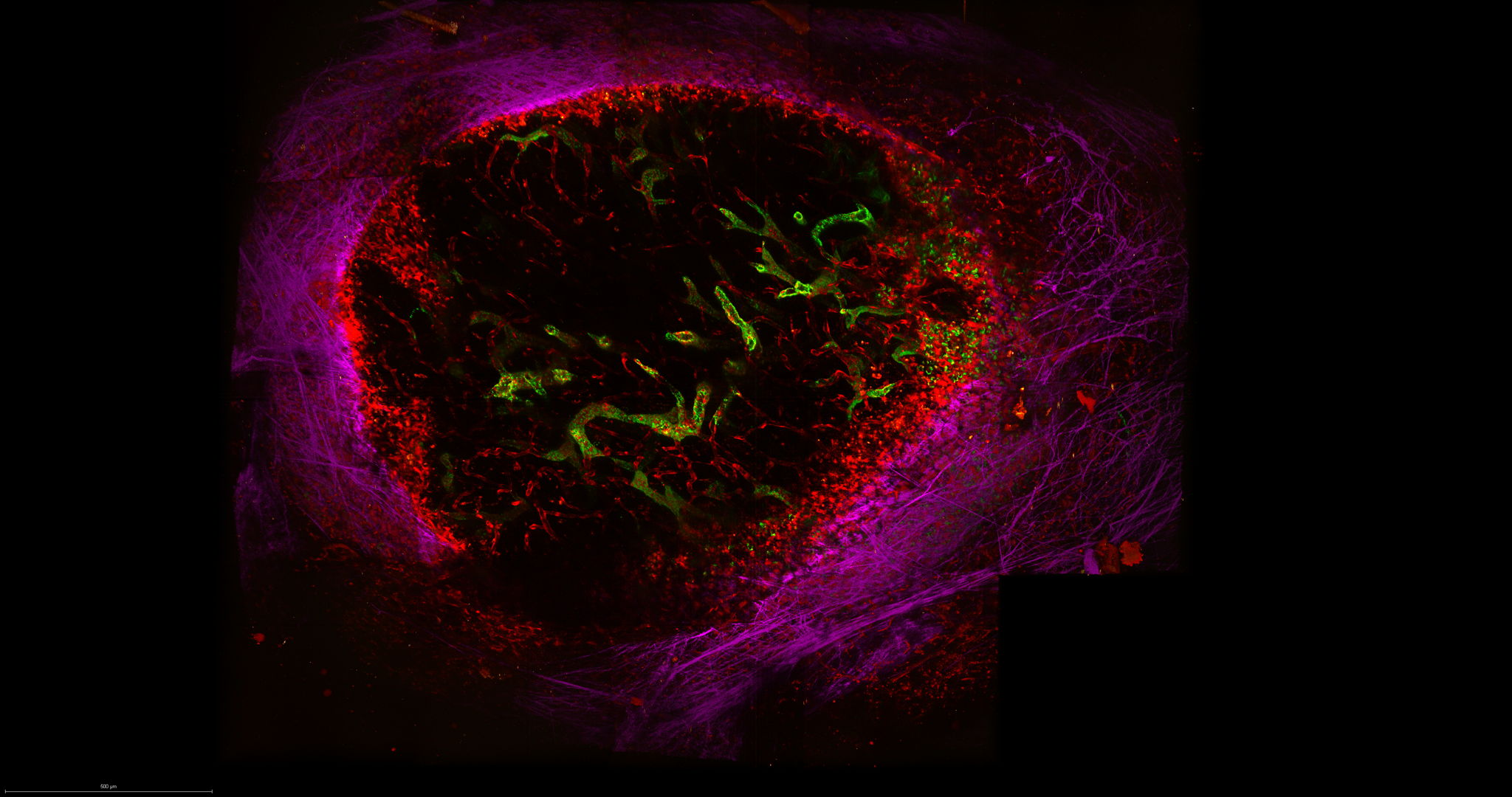
%20and%20thick%20high%20endothelial%20venules%20(green)%20in%20a%20mouse%20lymph%20node.png "Intravital imaging of thin blood vessels (red) and thick high endothelial venules (green) in a mouse lymph node. (Courtesy of Kathryn Jacobs)")
How our body's natural recycling system could help reduce inflammation
Leuven, Belgium, 28 July 2026 – Researchers at VIB and KU Leuven, together with international collaborators, have discovered that blocking autophagy – the body's natural recycling system for worn-out cell components – in specialized blood vessels can reduce inflammation in mice with psoriasis. Unlike many current therapies, this strategy reduces inflammation without weakening the immune system. The findings, published in the journal Immunity, reveal a promising new approach for treating chronic inflammatory and autoimmune diseases.
The blood vessels that guide immune cells
The lymph nodes are important organs of the immune system responsible for coordinating immune responses and filtering pathogens from blood and lymph. As lymph circulates through the body, it can transport bacteria, viruses, or even metastatic cancer cells into the lymph nodes, where they can be eliminated by immune cells such as lymphocytes.
These immune cells enter the lymph nodes from the bloodstream via specialized blood vessels called high endothelial venules (HEVs). HEVs transport circulating lymphocytes into the lymph nodes by capturing them with specialized adhesion molecules called peripheral node addressins (PNAd).
"For a vessel to be an HEV, its cells must harbor PNAds on its surface," explains first author Dr Kathryn Jacobs (VIB-KU Leuven). "You can think of it as a 'sticky coating' that signals immune cells to leave the bloodstream and enter the lymph nodes."
Without autophagy, HEVs lose their ability to recruit immune cells
During infection and inflammation, HEVs increase their production of PNAd to recruit more lymphocytes and strengthen the immune response. This same process, however, can worsen symptoms of chronic inflammatory and autoimmune diseases by promoting the continuous influx of immune cells. Understanding how PNAd production is regulated is therefore crucial for developing better treatments. Yet the underlying mechanism has remained largely unknown.
In this study, the research team led by Prof Gabriele Bergers at the VIB-KU Leuven Center for Cancer Biology discovered that autophagy – a cellular process that recycles old or damaged components – is essential for sustaining PNAd production and maintaining HEV function. When autophagy was blocked, PNAd production declined, HEVs lost their specialized identity, with far fewer lymphocytes able to enter the lymph nodes.
"What's really interesting is that if you block autophagy in other types of blood vessels you get the opposite – an increased inflammatory response – so autophagy plays a really unique role in HEVs," explains Dr Jacobs.

A new approach to treating chronic inflammation
The researchers next investigated whether disrupting HEV function could help treat chronic inflammatory disease without targeting the immune system directly, focusing on psoriasis – a chronic autoimmune skin disease that affects around 125 million people worldwide. HEVs can develop within psoriatic skin lesions, where they recruit immune cells and sustain local inflammation. Although several treatments are available, most work by suppressing the immune system, which can increase patients' risk of serious infections.
Using a mouse model of psoriasis and a range of cutting-edge techniques, the team at VIB-KU Leuven disrupted autophagy specifically in HEVs to understand its role in inflammation. Results showed reduced immune cell recruitment and a consequent decrease in skin inflammation. To test whether this effect could be reproduced pharmacologically, the researchers also treated mice with a drug that blocks a signaling receptor that HEVs depend on to form and function. This drug treatment reproduced the effects of blocking autophagy, reducing both immune cell infiltration and inflammation in the skin.
"Our findings show that targeting HEVs instead of immune cells could offer a promising strategy to reduce inflammation while preserving normal immune function," explains Prof Gabriele Bergers (VIB-KU Leuven). "While further work is needed before this research can be translated to patients, the study identifies HEVs as a promising new therapeutic target for chronic inflammatory and autoimmune diseases."
Looking ahead, the team hopes to build on these findings by improving the LTβR-blocking drugs already used in the study.
"It would be interesting to see whether we can make better LTβR antagonists in the future," says Dr Jacobs. "If we could make a better antagonist, it could help treat not only psoriasis but a variety of autoimmune diseases by toning down the immune response without targeting the immune cells directly."
Publication
Autophagy maintains high endothelial venule identity and function during inflammation. Jacobs et al. Immunity, 2026. DOI: 10.1016/j.immuni.2026.06.020.
Funding
This research was supported by funding from the European Research Council (ERC), the Research Foundation – Flanders (FWO), the German Research Foundation (DFG), the iBOF Atlantis consortium, the EOS MetaNiche consortium, and the NRW-Nachwuchsgruppenprogramm.

Maria Zacarias

Kristof Windels